djust 1.2: More Django-Compatible, Much Faster
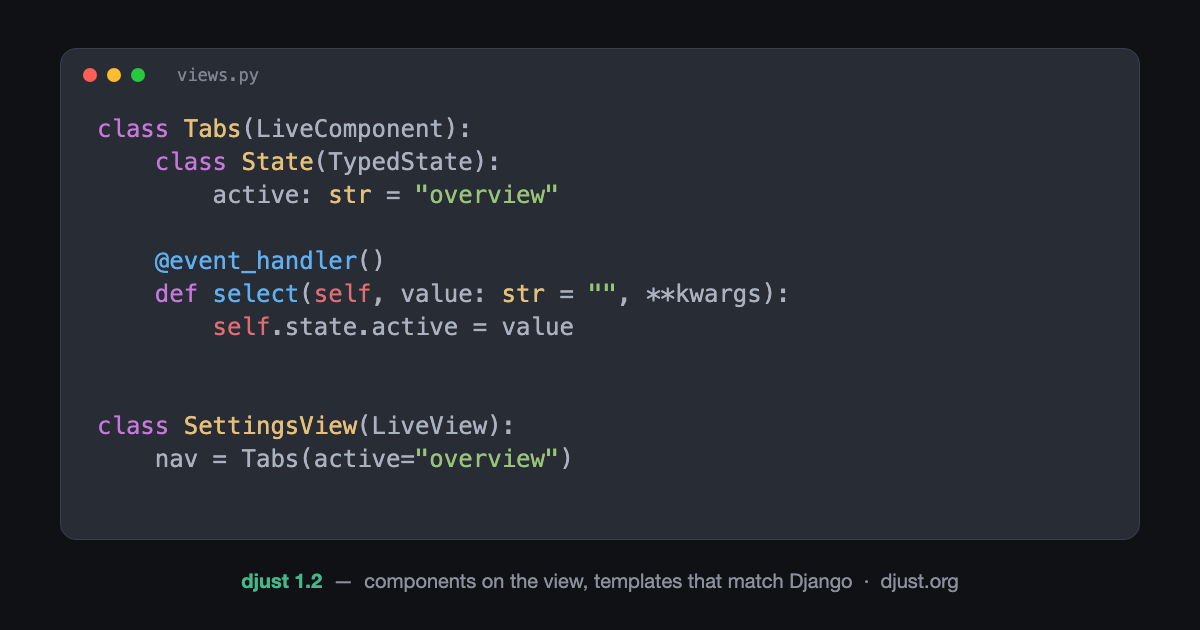
djust 1.2 passes 98.6% of Django's own template test suite, renders loop-heavy templates up to 45x faster than earlier releases, and adds class-level components, djust init and component-level testing.
7 posts

djust 1.2 passes 98.6% of Django's own template test suite, renders loop-heavy templates up to 45x faster than earlier releases, and adds class-level components, djust init and component-level testing.

djust 0.2.2 transforms the debug panel from a static inspector into a live development companion. Event filtering, replay, network inspection, VDOM patch tracing, and live state updates via WebSocket — all wired up and working out of the box.

djust's JIT serialization pipeline analyzes your templates at render time, generates optimized serializer code, eliminates N+1 queries, and falls back gracefully when Rust can't reach @property attributes. Here's exactly how it works, and what we did to make it fast.

djust 0.2.0 ships template and/or/in operators, critical VDOM diffing and whitespace fixes, a new dj- event prefix, and major dependency upgrades. Here's what changed and how to upgrade.

djust is a Django framework for building reactive, real-time applications in pure Python — powered by a Rust VDOM engine with 30x faster rendering than Django templates. No JavaScript framework required.

djust v0.1.6 brings major template system improvements including {% url %} tag support, {% include %} fixes, comparison operators in {% if %} conditions, and automatic Django type serialization.

Already have a Django project? Learn how to incrementally adopt djust to add real-time features without rewriting your entire application.